

Engagement changes from audience to audience, so be sure you always check your metrics to measure how these tactics affect your results. Email benchmarks provide good information, but the only true standard for engagement is measuring how your emails perform over time.
What percent of emails do people actually open?
Only 31% of consumers open at least half of their emails!
What emails do people open most?
Like you, they like emails that are relevant, of value, and indicate personal connection.
Why do they not open emails?
Being busy, not prioritizing email in general, and good ole fashioned “irrelevance.”
What percentage of the emails in their inbox does an audience actually open?
Only 31% of consumers open “most emails” (at least half), meanwhile, 40% open less than half of their emails, and 17.6% of people rarely open emails.
Insight
These results show the importance of cutting through the noise. Your contacts only allocate so much time and attention to their inboxes. So if you increase your communications from 4 to 8 emails per month, you may expect more unique opens, but the overall open rate to drop slightly. Keep track of industry benchmarks to know if your emails see a healthy open rate and and adjust content according to the priorities of your audience.
Get started with iLoyal Email Studio
Plans that flex to your needs and budget. Do it yourself or ask iLoyal for help with templates, graphics, list management, and more.
What kind of emails are people most likely to open?
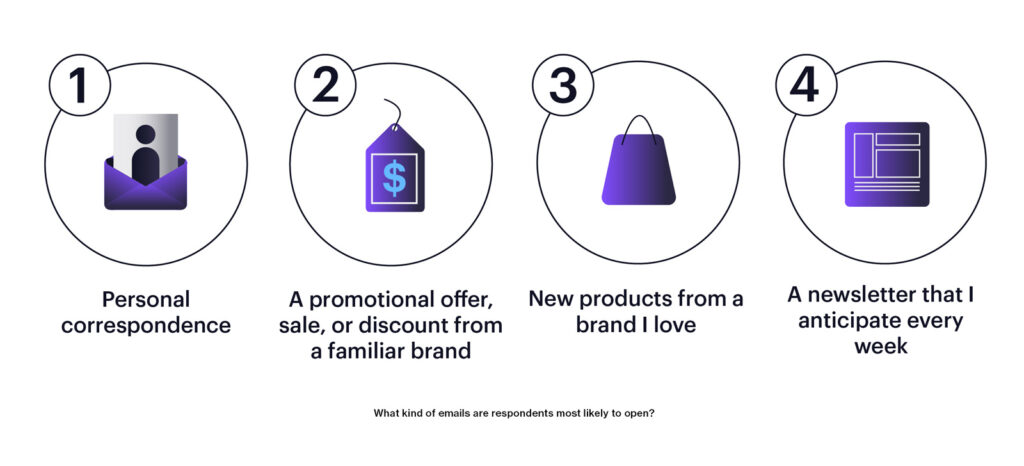
Let’s face it, you open emails that are important, relevant, of value, and personal to you – and so does your audience. Here’s a run down of the rank ordering of various types of correspondence.
- Personal correspondence
- A promotional offer, sale, or discount from a familiar brand
- New products from a brand I love
- A newsletter that I anticipate every week
- A promotional offer, sale, or discount from an unfamiliar brand
- Content that feels created just for me
- Tips and tricks that will improve my life
- Emails with an interesting subject line
- Insider information about a product or industry I’m interested in
- Content from a blog I follow
Insight
Cultivating affection is a strong theme in the top ranked email types (read: personal, familiar, love, anticipate). This common thread shows that your contacts are most likely to open your emails when they’re familiar with your brand and love what your company is all about.
The second half of this list consists of types of content that performs well on blogs and websites. This ranking shows that rolling this content into a singular newsletter that subscribers can anticipate may lead to more engagement—rather than sending separate emails dedicated to each individual type of content, especially considering that most people open less than half of the total emails in their inboxes.
Even though people say the are likely to open emails from unfamiliar brands, you shouldn’t be emailing anyone who hasn’t explicitly given you permission.
Why do emails not get opened?
There are a lot of reasons an email may not get opened. It could have absolutely nothing to do with your subject line or brand – or it could be exactly your subject and brand! Only the recipient knows, but iLoyal can help increase opens by applying our email best-practices to your audience:
- I don’t recognize who the email is from.
- It’s not relevant to me.
- I receive too many emails.
- I initially signed up to a list for an offer and have already received the promised reward.
- I’m too busy.
- I don’t check my email often.
Insight
Make it personal: Clearly communicate who you are and where you’re from. You don’t want subscribers to mistake your email for a phishing attempt, or ignore it altogether because they don’t recognize it.
One great way to maintain a personalized approach to email marketing while keeping your role clear: Consider changing your from information to a person’s name and your company.
For example, you’d probably be more likely to open an email from “Amy @ iLoyal” than from “iLoyal, Inc.” or “no-reply.” Yes some people still use that no-reply label (ugh!)
This transparency builds trust with your audience while balancing ‘personal’ and ‘professional.’
Send relevant content. You won’t hold onto your subscribers if you send information they don’t care about. Dig deep into your data to create specific segments that allow personalized, targeted email content.
For example, iLoyal takes a look at our clients offerings and makes recommendations for segments and personal merge fields like Visit Frequency, Favorite Menu Items, # of Properties Owned, and so forth – usually from surveys we design to get this customer intelligence.
